How Cinema 4D and Online Render Farms Dominate the Ident and OBB Market

Article / 22 March 2023

 By Alex Jerome

A Brief History

In the world of film and television, creating a unique and memorable visual identity is crucial. One way to achieve this is through Ident and OBBs which are the opening sequences or promotional trailers that play at the beginning of TV shows, films, or online videos. The Ident and OBB market has grown exponentially in recent years, with an increasing demand for visually striking and memorable brand identities. 

Dating back to the 1950s, television networks and stations would typically run simple short animations or live-action sequences with maybe a station logo and a jingle. In the 1970s broadcasting became more sophisticated and competitive, and production companies specializing in Idents and OBBs emerged. In the 1990s and 2000s digital technology led to huge changes as companies began to use computer graphics and animation. Today the ident and OBB market is a thriving industry, with designers creating high-quality and unique branding elements for many different markets.

Cinema 4D is a powerful 3D modeling, animation, and rendering software that has become a staple in the film and television industry for creating Ident and OBB sequences. It offers an extensive range of features and capabilities that enable designers to create complex 3D animations with ease.

Render farms, on the other hand, are cloud-based rendering services that allow users to outsource their rendering tasks to a network of powerful computers. These farms offer a cost-effective solution for rendering high-quality graphics quickly and efficiently, without the need for expensive hardware.

The Ident and OBB market is highly competitive, and to stand out, designers need to have access to the latest tools and technologies. Cinema 4D and cloud rendering services are two such tools that have become increasingly popular in the industry due to their speed, efficiency, and high-quality output. Understanding how these tools work and their impact on the Ident and OBB market is crucial for staying competitive and producing exceptional work.

Credit: Majazul Haq

Cinema 4D and Online Render Farms Impact the Ident Market

Cinema 4D was first released in 1990 and has since become one of the most popular tools for creating 3D graphics and animations in the film and television industry. Offering a wide range of features and capabilities that make it an ideal tool for creating Ident and OBB sequences. Some of the key features include an easy-to-use interface that is user-friendly and allows designers to navigate and create complex 3D animations. It boasts advanced modeling tools that allow designers to create complex objects and shapes with ease. Along with powerful animation tools that make animating fun and intuitive. Photorealistic rendering that now includes Redshift with the software. Finally, third-party plugin support has an innovative, creative and thriving community behind it.

Online render farms are cloud-based services that allow their users to outsource their rendering tasks to a network of powerful computers. Render farms are a cost-effective solution for rendering high-quality graphics quickly and efficiently, without the need for expensive hardware.

The use of a render farm service offers several advantages for designers working on Ident and OBB projects. First, they are very cost-effective, offering different levels of pricing and packaging based on your individual needs. Then there’s the render time, with the choice of CPU or GPU rendering and 3rd party plugin support, the render time is blazing fast. This is fantastic when deadlines are key, and projects need fast turnaround times.

Traditional rendering methods often require very expensive hardware and can take a long time to render high-quality sequences. Cloud rendering services eliminate the need for expensive hardware and allow the designer to focus on creating rather than worrying about if their system can render their job effectively and efficiently. On top of that, the speeds that an online render farm can offer you would be hard to achieve. Some render farms even have plugins that make the whole rendering process from beginning to end fast, smooth and worry-free.

Credit: Adi Rahman Rovianto

In Demand

The Ident and OBB markets have become increasingly competitive, with a growing demand for visually striking brand identities. To meet this demand, designers are turning to tools and services like Cinema 4D render farms to create their designs quickly and efficiently.

Cinema 4D and online render farms have become the go-to tools for designers working on Ident and OBB projects. Cinema 4D’s advanced modeling and animation tools, combined with its powerful rendering engine, make it an ideal tool for creating complex 3D graphics and animations. Online render farms offer a cost-effective and efficient solution for rendering these graphics without the need for expensive hardware.

While there are other tools and technologies available, Cinema 4D and online render farms offer several advantages over their competitors. Other 3D modeling and animation software may not offer the same level of ease of use or advanced features. Traditional rendering methods can be expensive and time-consuming compared to online render farms.

Future Trends and Developments

As technology continues to advance, it is likely that we will see new tools and technologies emerge. For example, machine learning and AI may play a larger role in creating these designs in the future. It is important for designers to stay up-to-date with these advancements to remain competitive in the market.

Furthermore, Cinema 4D and online render farms have also adapted to the rise of remote work in the industry. With more and more designers working from home or collaborating with remote teams, both Cinema 4D and online render farms have introduced features and tools that allow for seamless remote collaboration and workflow management.

Staying updated with advancements in technology is crucial for designers working in the Ident and OBB market. By using the latest tools and technologies, designers can create amazing visuals and tell stories that stand out in a crowded industry.

Cinema 4D and online render farms have become dominant players in the Ident and OBB market, offering designers a cost-effective and efficient solution for creating high-impact and visually striking brand identities.

----

Originally published at https://garagefarm.net.
Visualizing Interior Design ideas through cloud rendering

Article / 07 March 2023

By Sabrina Facchetti

Interior design is one of the most popular and fascinating branches of the design industry, and also one of the most elaborate ones. It requires good communication and coordination among all the parties involved to make things happen.  Typically, interior design studios have entire teams working on a project because there are so many aspects and details to take into account that it would simply be too much for a single person to handle.

 Additionally, there is communication with the clients who may have different ideas or may not be entirely sure of what they want to achieve. Often, clients have a sense of what they would like to create for their home, rather than clear and defined ideas. This puts the interior design team in the condition to work on different concepts simultaneously to show the client various courses of action from the outset of a new project. In this situation relying on cloud rendering can be incredibly helpful to visualize the environment, the mood and the atmosphere of the new space.

Render fast and in high quality in the cloud

The key to success in a fast-paced world like the one we are living in is the ability to deliver high quality in the shortest time possible. Clients are often impatient to see results, and sometimes they don’t have a sophisticated level of imagination to visualize the space with the information collected in a preliminary mood board.

Creating digital spaces and rendering atmospheres, including lighting and different moments of the day alongside color palettes, is one of the most powerful tools that interior designers possess to impress clients and help them better define their ideas. An interior design project is much more than putting together furniture; it is designing spaces with people in mind, creating spaces for life, work, or entertainment, and all these functions need to be supported not only by objects but also by colors, finishing, and, last but not least, light.

How the light is going to interact with all the other elements is vital and is going to play a key role in the final atmosphere of the space. And this is actually what makes interior design renderings pretty complicated projects that usually require quite some time to render. To have an accurate and realistic recreation of the space, the settings to render lights and materials need to be very specific, which usually means working with more minute parameters.

This is where cloud rendering comes to our aid. Cloud rendering means that it is not our machine that is going to do all the computing work to render the interior, but several virtual machines on a remote server, and you only pay for what you use. This also means that while rendering in the cloud, the productivity of a studio can still be high, and designers can focus on other projects or meet with clients instead of having to wait for their machines to complete the renderings. And based on your needs, you can scale the process up or down, managing how fast you need your renderings to be computed, making the process entirely flexible and tailored to each individual need.

Popular render farm services such as GarageFarm.NET offer a wide pool of cloud-supported software where you upload your scene from your local device and have the remote server take care of the rendering. You pick the priority and the hardware configuration you need and pay correspondingly. Once the render farm service has finished your frames, you can download your images and show them to your clients.

An example of an interior design mood board (Credit: Soumya Jain)

Communicating via images

The key to a successful project is always good communication especially when there are many people involved in taking care of different aspects and when the team has to deal with clients. Sometimes clients don’t have a clear vision of what they want, sometimes they don’t have a vision at all and sometimes they need to actually see their ideas visualized as a 3D rendering to realize that they might not work or that they didn’t like the concept as much as they thought. 

All these issues are part of the game, and if, on one side a good team can develop its own internal strategies to perform at its best, when it comes to dealing with clients every project and approach is different. Some clients might need to see multiple versions of the same concept before being convinced of what they want, while others might want to see different options and still have a hard time picking the right one. 

These situations can be time-consuming, especially when dealing with tight deadlines. Having the possibility to rely on a service that allows the creatives to be free to work on a few extra options while the remote server is completing the renderings can be vital.

An example of an interior design rendering in the daylight (Credit: Ton Alves)

Visualizing ideas

One of the most important things when it comes to interior design projects is to make the clients aware of the efforts that each step of the design process requires in order to set realistic expectations in terms of time and costs. My friend Sarah is an amazing interior designer in New York and she has mentioned many times how communication with clients is vital. It can be easy to think that an idea could work but then when the layout and the renderings are presented, clients might realize they want to go in a different direction. This means the design team has to develop another solution. 

Sometimes seeing the same space during different moments of the day can help to decide if a solution is going to work or not and then adjust. Cloud rendering can really cut the computing time down to seconds or minutes compared to hours or days, making project development much smoother and efficient. 

Mindful of the preparation lead time necessary to recreate a space in 3D with all the elements, lights, colors and finishing, is then a matter of setting the cameras and picking the priority before receiving back the final files as still images or animations/frames if necessary. Potential virtual tours of the interiors can also be set to impress the client and convince them of a particular layout and cloud rendering is the solution.

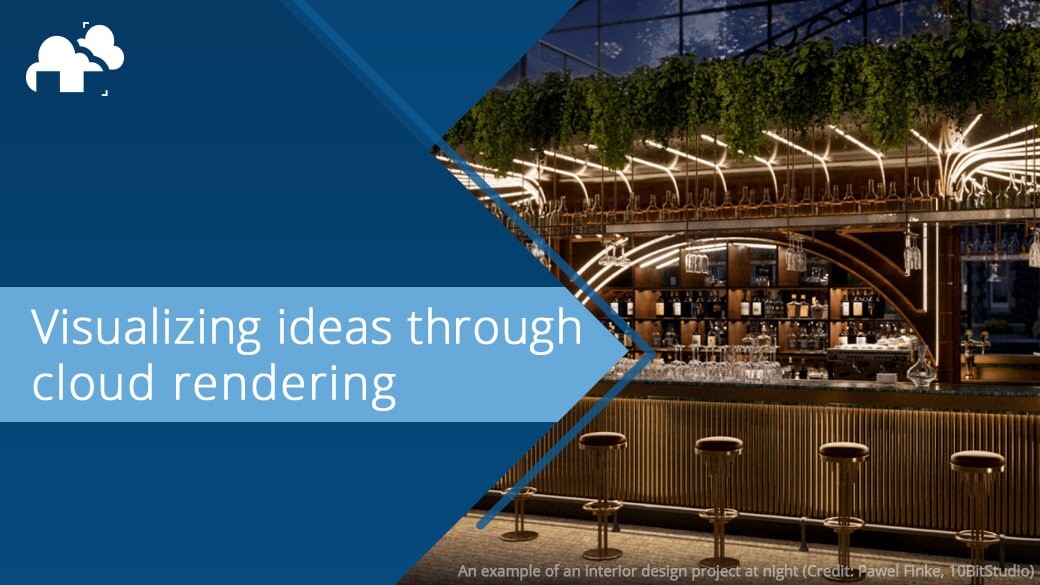
An example of an interior design project at night (Credit: Pawel Finke, 10BitStudio)

Conclusion

With many manufacturers creating 3D versions of their products and having them available for design studios, the creation of digital spaces and previews is becoming more and more commonplace and not only for bigger studios. The possibility to offer clients real views of the space and in a reasonable time make changes to better answer their requests is a powerful workflow afforded by a cloud rendering service. This grants good results also during the construction phase, making both the designers’ and the clients’ lives easier.

----

Originally published at https://garagefarm.net.

What is cloud rendering

Article / 02 March 2023

If you’ve been enjoying Photoshop’s latest neural filters, working on CAD or adding motion capture data to your 3D characters online, you’ve been engaging with cloud-based technology. It’s everywhere these days, and while the turning of the technological tide will eventually bring forth an alternative, cloud computing has been a boon for digital content creators – especially those that work with 3D. One of the more deeply embedded applications of cloud computing in the 3D computer graphics industry is cloud rendering. 

Cloud rendering has become an increasingly popular option for professionals who need to create high-quality 3D content with often short and rigid deadlines. By leveraging the power of cloud computing, we can produce more complex and detailed scenes in a shorter amount of time and with less investment in hardware. In this article, we’ll take a closer look at what cloud rendering is, its advantages, applications, challenges, and the future of this technology.

‍For affordable, easy-to-use and robust cloud rendering solutions with human support, have a look at our online render farm and have a chat with our team at any time of the day!

Cloud rendering, in a nutshell

Server racks in a cloud rendering data center

If cloud computing is a technology that allows users to access and use computing resources over the internet, cloud rendering takes this one step further by leveraging these remote computing resources to render 3D graphics and animations. Instead of rendering 3D scenes on a local computer, the data parsing and processing are done on remote servers in the cloud. 

The benefits of this are felt the most in rendering 3D animation, since instead of rendering one image after another in sequence on a single machine, all images or frames that comprise an animation can render concurrently. All of the final output is then sent back to the user's workstation, to be edited further before being converted into a video. This means a complex scene that would take over an hour for every frame in the sequence would finish rendering in just a little more than an hour since all the frames are rendering at the same time. 

In short, cloud rendering refers to the process of parallelizing rendering digital graphics and animations by having multiple machines each render a frame or even sections of a frame on remote servers over the internet. A local computer or workstation no matter how powerful would still need to render frames one after the other. This allows for more efficient and cost-effective rendering, as well as the ability to tap into a large network of computers for increased processing power.

Why go cloud?

While cloud rendering services offer many advantages over maintaining an on-premise render farm, one of its biggest draws is the freedom from upkeep costs.

Traditional render farms require a large upfront investment in hardware, software licenses, and IT infrastructure to set up and maintain the rendering farm. In contrast, cloud render farms provide access to computing resources on a pay-per-use basis, allowing for greater flexibility and scalability in resource allocation.

Additionally, traditional render farms typically require a significant amount of time and resources to set up and maintain, while cloud render farms can be set up quickly and easily without any hardware or software installation. However, the cost of using cloud render farms can quickly add up if the project requires a large amount of computing resources or if the rendering time is extensive.

Here's a hypothetical loose breakdown of costs for maintaining a traditional render farm and using a cloud rendering service:

Traditional render farm:

  • Hardware costs: $50,000 - $100,000+
  • Software costs: $10,000+
  • Electricity costs: $500 - $1,000+ per month
  • Cooling costs: $500 - $1,000+ per month
  • Maintenance and repair costs: $2,000+ per year
  • IT support costs: $2,000+ per year
  • Render farm manager salary: $40,000+ per year

Total cost per year: $80,000 - $150,000+

Cloud rendering service:

  • Cloud rendering costs: $0.10 - $1.00+ per GHz hour
  • Data transfer costs: $0.02 - $0.12+ per GB
  • Licensing costs: Included in the rendering costs
  • No hardware, electricity, or cooling costs
  • No maintenance or repair costs
  • No IT support costs
  • No render farm manager salary

Total cost per year: $10,000 - $50,000+

Of course, these costs will vary depending on the size of your render farm or the scale of your rendering needs. However, in general, using a cloud rendering service can be a more cost-effective solution, particularly for small to medium-sized businesses or freelance artists.

Advantages of cloud rendering

While local or in-house render farms have been and continue to be used by some larger studios, cloud rendering can give smaller studios and individuals a much-needed competitive edge. Some of the advantages it offers are:

‍A. Scalability: One of the key advantages of cloud rendering is its scalability. As the needs of your projects change, the resources available in the cloud can be adjusted accordingly, allowing you to handle larger and more complex projects without having to invest in additional hardware.

‍B. Accessibility: Cloud rendering also provides greater accessibility to professionals working in the 3D graphics industry. With the ability to access and use computing resources over the internet, it's possible to collaborate with others from different locations and to work from anywhere, at any time.

‍C. Cost-effectiveness: Another important advantage of cloud rendering is its cost-effectiveness. Rather than having to invest in expensive hardware, cloud rendering allows you to access the computing resources you need on an as-needed basis, reducing upfront costs and ongoing expenses.

‍D. Improved performance: With cloud rendering, you can tap into the power of remote servers to perform rendering tasks, resulting in improved performance. By offloading processing to the cloud, you can free up your local machine for other tasks and improve overall workflow.

Applications of cloud rendering

A. Architecture and Interior Design: Cloud rendering is widely used in the architecture and interior design industry, allowing designers and architects to create high-quality 3D visualizations of their designs quickly and easily.

B. Gaming: The gaming industry is another area that benefits greatly from cloud rendering. With the ability to access powerful remote servers, game developers can create more complex and detailed graphics, resulting in a better gaming experience for players.

C. Film and Animation: The film and animation industry also relies heavily on cloud rendering. With the ability to render complex scenes and animations in a shorter amount of time, filmmakers and animators can create high-quality content faster and more efficiently.

D. Product Design and Engineering: In the product design and engineering industry, cloud rendering is used to create high-quality 3D visualizations of products, allowing designers and engineers to refine their designs before going into production.

Challenges of cloud rendering and their solutions

While cloud rendering offers many benefits, it also comes with its own set of challenges. Fortunately, many online render farm services are available that handle them: 

  1. Security and privacy - Protecting sensitive data in the cloud is a significant concern for many organizations. Online render farms employ robust security measures, such as encryption and secure data storage, to protect the sensitive information and assets of their customers. This includes customer data, project files, and renderings, which are kept secure both in transit and at rest.
  2. Data management - Managing large amounts of data and ensuring data availability can be challenging in a cloud environment. Online render farms use advanced data management techniques, such as data replication and backup, to ensure that customer data is safe and secure. This helps to reduce the risk of data loss or corruption and ensures that customer data is always available when needed.
  3. Internet connectivity - The quality and speed of internet connectivity can affect the performance of cloud rendering. To ensure reliable and fast rendering performance, online render farms use high-speed and low-latency internet connections. This helps to reduce the risk of slowdowns or interruptions, ensuring that customers get the fast and reliable rendering performance they need.
  4. Cost management - Balancing the cost of cloud rendering with the benefits it provides can be challenging for some organizations. Online render farms use cost-effective cloud computing solutions to provide affordable rendering services to their customers. This includes using cost-effective hardware and software solutions, as well as implementing cost-saving measures, such as energy-efficient computing practices.

Types of cloud rendering services

There are various types of cloud rendering services available to artists and studios that offer an array of options for rendering their projects. From cloud-based solutions that reduce render times, to distributed rendering systems that utilize the power of multiple computers, each service caters to a different need.

One such model is the Cooperative Distributed Rendering System, in which users can render their projects on other users' computers for free. While this model is community-based and cost-effective, it comes with some drawbacks, including a lack of data security and support, making it less suitable for professional projects with tight deadlines.

Another popular model is Infrastructure as a Service (IaaS), which offers users a high level of customization and scalability, allowing them to create their own cloud pipeline according to their specific needs. While this model is perfect for big studios with large projects that require a custom solution, it is time-consuming to configure and requires in-house technical support to maintain the pipeline.

For a more automated approach to cloud rendering, users can turn to cloud render farm services such as ours at GarageFarm.NET. This model provides an all-inclusive service, allowing users to upload their project and dependencies to the service provider's file server, interface with their rendering management software from a browser, and pay only for the volume of rendered data with no additional fees for software setup, support, and tools provided by the farm.

Technical requirements for cloud rendering

The technical requirements of cloud rendering can vary depending on the specific service being used. In general, a computer with a modern web browser and a reliable internet connection is necessary for uploading project files and managing the rendering process through the service provider's web interface. Additionally, the rendering service may have specific software requirements for the 3D modeling or animation software being used. The hardware requirements can also vary depending on the complexity and size of the project being rendered, with more complex projects requiring more processing power and memory. Some cloud rendering services may offer access to high-performance hardware, such as powerful CPUs or GPUs, to speed up the rendering process.

The future

Ultimately, cloud rendering service providers are the modern answer to the increasing demand and time constraints for animated 3D visualization and high-resolution 3D rendering. Rendering farm services are one of the most prominent adopters of this technology, and have become integral to production across many, if not most, of the 3D computer graphics industries. Even with all of the new, disruptive technology on the rise, cloud rendering will always hold a place in the 3D visualization workflow.

----

Originally published at https://garagefarm.net.

Robots who render

Article / 24 February 2023

We explore the role of artificial intelligence in 3D production, what it could mean for the future of 3D modeling, rendering and render farms

In 2022, everybody and their grandmas switched their profile photos to artsy renditions of their faces. From Chance the Rapper to Lebron James, these colorful and flattering avatars flooded social media seemingly overnight. 

Many were delighted. Also, many went up in arms against them. 

Why? Because the profile photo artworks were generated by artificial intelligence (AI) through an app called Lensa. The images sparked conversations (even outrage) about whether these AI platforms plagiarized the artists on whose artworks the AI was trained, and whether software like Lensa, Dall-E, and Jasper will eventually (some say soon) kick artists out of their jobs.

DALL-E 2

Now, whichever side you may land on regarding this debate, one thing is undeniable: AI is disrupting almost every field of human activity, from dating apps to smart homes, stock trading to chess playing, launching marketing campaigns to solving climate challenges. And as the popularity of Lensa and text-to-image platforms have made clear, the creative arts are not exempt from the coming of AI.

This includes what until now has been the human labor- and talent-intensive field of creating 3D graphics. What’s AI got to do with 3D?

AI, by its very nature (weird to use the word “nature” for something artificial but here we are; I digress), can be trained to do pretty much anything and with that, its impact on 3D can range from automating specific parts of the 3D workflow to potentially taking over the whole workflow itself. And one of the more exciting (or scary, depending on who you ask) areas of AI development regarding 3D is its application to modeling.

AI and 3D modeling

Modeling is the first part of the 3D workflow and it deals with creating a 3-dimensional representation of an object or surface. It is painstaking and laborious, and takes a long time to master. 3D modeling artists fall somewhere in between a fine artist and a tech wiz: they must have a good grasp of anatomy (when modeling characters) or architecture (when dealing with spaces and structures) while also being masters of software tools and commands and parameters.

But imagine being able to take a short video of an object using your phone camera, feeding that video into software, and getting a working 3D model of that object in a matter of minutes. This is exactly what Nvidia’s Instant NeRF technology does. In fact, Instant NeRF doesn’t stop at just 3D modeling – it goes all the way to outputting a completely textured, lighted, and rendered 3D scene from just a small set of static images or a short video shot with your phone. 

Yes, AI just did that. 

Amazing? Terrifying? Again, depends on who you ask. But even as we are just in the early days of AI, the fact is it can already do this. It is here. And it will only get better, faster, cheaper.

AI and 3D rendering

Let’s now jump to the last part of the 3D workflow – rendering – and see what impact AI has on it. Rendering is the part of the process where the 3D scene you’ve meticulously modeled, textured, and lighted is converted into 2D so that it can be viewed properly as an image or video on 2D screens like your phone screen or TV or cinema. 

This description may sound simple but a lot goes into this process. As such, there are many ways that AI can be applied. 

For example: let’s say you have a low-resolution, low-frame rate animation that you want to scale up to 4K. How could you go about doing it? Traditionally, you’d go back to the original project file in the 3D software and re-render the whole thing in the higher resolution that you want. But with AI, you can do it without having to access the original project at all. Software like Flowframes lets you upscale a low-res 3D material to a higher resolution. This process is called interpolation.

Because AI can do this, it opens up possibilities for 3D artists and firms looking to be more efficient. Now they can render frames fast using lower resolutions (perhaps using their own computers) then just upscale using AI after.

Now, does this mean the end for 3D render farms?

AI and 3D render farms

Throughout history, there have always been winners and losers every time new technology gains mainstream adoption. Writing and publishing made town criers irrelevant. Cars relegated horses to farms and races. Mobile phones killed the jobs of pager operators. The internet led to the decline of print news, brick and mortar bookstores, and encyclopedias. 

But there have also been technologies that led to the evolution of jobs and roles, not necessarily to their eradication – bank tellers remained even when ATMs arrived, referees are still on the field even with VAR, online news is still written by professional journalists (but yes, there are also “news” published by non-journalists). 

And this is how, I think, AI will impact cloud render services – evolve them, not end them.

Sure, AI can help individual 3D artists and firms render on their own (as described earlier) but AI can also help render farms optimize their operations, leading to faster speeds and lower costs that will make rendering locally simply impractical and inadvisable.

The hardware side of render farms is what will continue to make it a relevant service for 3D artists and firms. AI is software and, therefore, can only offer software-side improvements to the workflow. Rendering, because it is by nature computational, will always require beefy hardware to be efficient. More CPU cores and more GPU memory will always mean faster and better at least for rendering. And as 3D technology advances, scenes will become more and more complex to render, demanding more and more hardware muscle.

Different 3D artists will, of course, feel the impact of AI on rendering differently. It is possible that for students or freelancers working on relatively smaller projects, AI may advance well enough to make local rendering practical. But for production-level projects where artists often operate at the cutting edge, even constantly pushing past it, the demand for powerful and efficient rendering solutions will likely always point to render farms. And since AI can also enhance render farms (AI can help optimize project sequencing, frame troubleshooting, node assignments, more advanced pricing schemes, etc.), AI can help render farms reach the point where it becomes a no-brainer to simply render with a farm.

In short, AI is simultaneously threatening and beneficial to render farms.

Conclusion

Make no mistake, AI is here. While I can see how it might lead to lessening the number of 3D artists needed to complete projects, AI won’t completely replace human talent, vision, and originality in 3D. 

On a similar note, AI will lead to both disruptions and improvements for 3D render farms. Future advancements in AI might lead to a smaller number of smaller projects being beamed up to cloud farms for rendering. But AI itself can also improve how render farms operate, leading to more efficiency and ensuring the relevance of render farms especially for larger scale projects. AI has the potential to advance render farm operations to the point that everyone and their grandmas are rendering with farms online.

---

Originally published at https://garagefarm.net.

The new Digital Fashion era

Article / 21 February 2023

Computer graphics, 3D design, predictive design, simulations, animations, and CG art, in general, have been around for quite some time, impacting fields from architecture to design, interiors, gaming, and 3D printing. However, for some reason, the fashion industry has remained immune to this digital revolution. As an Italian 3D artist and designer, I had the chance to speak with manufacturers in my home country and noticed how the fashion world is deeply rooted in traditional ways of doing things. The industry is generally not open to experimenting with new technologies and approaches, which makes sense given that it is built upon tradition and savoir-faire. 

When the Covid-19 pandemic hit, the entire world came to a standstill, and even though things slowly returned to a new normal, the supply chain of materials was still affected. That's when CGI stepped in as the answer. With the ability to simulate garment design and textile patterns, using avatars for measurements and fittings, and applying predictive design techniques that have been successful in the architecture and design industries, the door has opened to a new era of digital creation in the fashion world.

‍Join the digital fashion revolution and embrace sustainability with GarageFarm.Net! Our powerful render farm is the perfect solution for fashion designers and companies looking to take their designs to the next level. With our online renderfarm, you can experience the freedom of creativity while making deadlines much more manageable. Embrace the future of fashion and make your designs come to life with our online render farm, sign up today!

Example of fabric with different patterns that I created for Balm Labs x Tongoro Studio Vol II

How render farms helped the fashion industry

Once the door to digital fashion fabrication was opened, the possibilities became endless, and new projects emerged at an incredible pace. Just like in design, architecture, and gaming, some projects can become very demanding in terms of performance and quality of the results, particularly when it comes to animations or full fashion shows featuring avatar models wearing digital replicas of actual garments or completely new designs.

Shudu, a CGI model from Diigitals, posing for The Compendium 2021

Rendering an entire fashion show on a single machine can be a challenging task, particularly when considering the demanding requirements of simulations on the GPU, the level of detail required for each element, and the realism of skin and hair on the models. A quick glance at the images gives a good sense of the amount of work that goes into creating a single still image. Multiplying this for the number of frames needed for a full show or sequence can result in several days or even more of rendering time, putting a heavy strain on even the most powerful computer.

In these cases, a reliable render farm service offers a perfect solution. Having access to an entire network of high-performance computers, each equipped with the most efficient GPUs, working simultaneously on specific sequences can reduce the rendering time to a tenth of its duration on a single machine.

A few scenes of the Lavie by CK catwalk featuring avatar models created by The Diigitals

A new predictive and sustainable approach

Once the digital fashion revolution began, the possibilities and potential of technology started to expand and encompass more aspects of the manufacturing process. Tools like Clo3D and Marvelous Designer, which were previously primarily used in the gaming industry, started to gain popularity not only for creating or recreating garments and accessories but also for making product development more efficient and sustainable by applying the predictive design principles of industrial design to fashion.

An example of a beachwear look and a stress analysis of the fabric and seams created with Clo3D, Sabrina Facchetti x Swatcheditor

The examples depicted above showcase the enormous potential of working in a digital environment. One side of the UI is dedicated to pattern creation, while the other side is dedicated to fitting and first previews. The physics of materials, along with gravity, are applied, and once the simulation starts, the software calculates all the relevant information, providing a realistic preview of the garment under development. Stress analysis can also be conducted to determine where the fabric, seams, or other details will be most affected.

 All this information, along with realistic avatars that can mimic the necessary measurements and proportions, enables us to define and adjust the design more efficiently than the traditional prototype-making process. Of course, the patterns and details from the simulation are not the final versions and minor adjustments will still need to be made before going into production. However, optimizing as much as possible and simulating real-world conditions without wasting time and materials on multiple prototype iterations is a highly efficient and sustainable way of approaching fashion design.

Why photorealism has become necessary

In terms of sustainability and efficiency, once the digital design is completed and perfected, it can be utilized for various other purposes. One of my favorites is the ability to produce realistic renderings that can assist brands in conducting market research and communicating with consumers to gain a more accurate understanding of what people want, thus further improving sustainability. In this scenario, render farms can be incredibly useful, especially when dealing with a large number of items to render or complex materials that demand specialized rendering capabilities, tight deadlines, or a combination of all.

An example of how Luxtra is working to develop a new collection that is not only made with sustainable materials but also in a way that meets the public’s taste and expectations.

Conclusion

We are moving towards a more conscious era where sustainability is not a choice but a necessity. Customers will inevitably prefer it over other options, and for brands and companies to respond to specific questions with more optimized procedures and processes will be crucial. This not only allows for greater freedom of creativity and experimentation, resulting in more unique creations but also opens up new horizons and promotes inclusivity.

------

By Sabrina Facchetti

Originally published at https://garagefarm.net

3D Computer Graphics and render farms: Making history with history

Article / 17 February 2023

A Virtual Reconstruction of Khor Fakkan by Global Digital Heritage

Museums and heritage organizations face a range of ethical and logistical problems in preserving and sharing cultural heritage. These include questions around ownership and access, representation and cultural sensitivity, conservation and preservation, privacy and security, among others. Digitization using 3D computer graphics and render farms presents an innovative solution to these challenges, offering a way to preserve cultural heritage and make it accessible to a wider audience. 

This technology is already being used to create detailed and accurate representations of historical treasures and heritage sites, from sculptures and relics to entire cities. And when it comes to rendering these representations, online render farm services are an invaluable tool. By capturing accurate digital representations of historical treasures and heritage sites, museums can address many of these problems and provide a modern and immersive way for future generations to interact with our collective past. 

Preserving and sharing cultural heritage is an important mission for museums and heritage organizations, and GarageFarm.NET can help. Whether you're creating detailed 3D models of historical relics and sites or working on virtual exhibitions, our render farm can help you get the job done faster and more efficiently.

 In this article we’ll explore this fascinating initiative and the integral roles 3D rendering and online render farm services play in making it all possible.

Photogrammetry

Photogrammetry is a technique used to capture accurate 3D representations of physical objects and spaces using photographs. This technology has been applied to the digitization of historical relics and sites, providing museums and heritage organizations with a powerful tool for preserving cultural heritage. The process involves taking a series of photographs of the artifact or site from various angles, and then using specialized software to process the images into a 3D model.

A 3D scan of a figurine of Casimir The Great, from the Virtual Museum of Malopolska

One of the key benefits of photogrammetry is that it allows for the creation of highly accurate digital representations of artifacts and sites, which can be used for a variety of purposes, from preservation and research to virtual exhibitions and educational programs. Photogrammetry also provides a non-invasive method for digitizing delicate or fragile objects, reducing the risk of damage during the digitization process.

Additionally, photogrammetry is a cost-effective solution for digitizing large-scale artifacts and sites, as it does not require the use of specialized equipment or skills. With the increasing availability of affordable photogrammetry software and high-resolution cameras, more and more museums and heritage organizations are turning to photogrammetry as a solution for digitizing their collections.

Photorealism and the 3D rendering pipeline

But sometimes the scanned model may not be perfect, that's where the 3D visualization workflow comes in. Artists can use 3D modeling, sculpting and texturing techniques to refine the model and make it as accurate as possible. The final result is a detailed and accurate 3D representation of the historical treasure or heritage site that can then be used to recreate a location or object as it would have been experienced in reality. 

In order to make the digitized treasures and heritage sites as realistic as possible, photorealistic visualizations are important. Photorealism is achieved by using advanced techniques that mimic the way light behaves in the real world as it interacts with different surfaces. Skilled operators of 3D software can produce images out of  digital models that are almost indistinguishable from actual photographs or video. 

Render of a scanned sculpture “Young Centaur (Smiling Centaur)” from Virtual Museums of Małopolska

However, producing the images is computationally expensive, and a high quality  animated tour of a museum collection for example, might take months to render on a few computers. Enter the render farm, which processes these images on multiple computers simultaneously, which speeds up the production process and makes creating immersive experiences out of digital collections feasible. 

Online render farm services are more cost-effective and wieldy than for museums or heritage institutions to invest and maintain their own host of computers since costs are only incurred when a project is actually rendered, and modern cloud render services offer tools to ensure that 3D project files are properly transferred from a personal machine to their file servers correctly, thus producing the correct resulting images on the rendering farm.

Virtual restoration

One amazing benefit of digitizing historical treasures and heritage sites is the ability to create virtual restorations. Virtual restoration allows us to see what a site or object looked like in its original condition, even if it's no longer possible to see it that way in real life.  Virtual restoration projects allow artists and archaeologists to bring historical treasures and heritage sites back to life through 3D computer graphics.

The process starts with detailed 3D scans or models of the artifact or site, and from there, artists can use 3D sculpting and texturing techniques to refine the model and bring it closer to its original condition. This is a valuable tool for researchers, as it allows them to study the original condition of a site, and for the public, as it offers a unique and immersive experience.

An example of a successful virtual restoration project is the virtual restoration of the temple of Bel in Palmyra, Syria. The temple was damaged during the Syrian Civil War, and with the help of 3D scanning and virtual restoration techniques, the temple was brought back to life, allowing visitors to explore it in its original condition.

This is, of course, only the beginning. Thanks to the growing accessibility of 3D rendering and online render farm services, in the near future, we can expect animated tours of ancient cities at the height of their prosperity, the ability to investigate extensively an ancient sculpture and much more. 

History’s VIrtual Reconstruction of Ancient Rome, in progress.

The future of the past at present

The role of 3D computer graphics and render farms in the digitization of historical treasures and heritage sites is crucial. From virtual restoration to virtual preservation, and from photorealistic visualizations to augmented reality, render farms offer a powerful tool for preserving and exploring our cultural heritage. The potential for 3D computer graphics and render farms to shape the future of museums and cultural institutions is exciting, and we look forward to seeing how this technology continues to evolve.

Preserving our cultural heritage is important, not just for us but for future generations. By leveraging the power of 3D computer graphics and render farms, we can ensure that these treasures and heritage sites are preserved and accessible for all to enjoy.

---

Originally published at https://garagefarm.net.

The height of motion graphics

Article / 24 January 2023

When I hear the phrase “visual effects,” I instinctively think of sci-fi, futuristic, hyperreal, cyberpunk, and augmented reality.

Takayuki Yoshida is all that – and more. Just take a look at his viral piece of short animation called Tokyo New Crosswalk Style:


When this first came out, many thought it was real. I did, too. Then after realizing it wasn’t, I started to wish it was. I am sure I wasn’t alone in wishing I could jump on a plane to Tokyo and cross the street somewhere in the city where the crosswalk signal lights jump to life and the pedestrian lanes make the world look like a scene from Blade Runner 2049 or a screengrab from Cyberpunk 2077.

This is what Takayuki Yoshida does. He mixes video and motion graphics and pushes the possibilities in both mediums. 

But that’s not all he does. Check out his showreel and you’ll see what I mean:


(If you need a quick and cost-efficient solution for rendering animation projects like these, check out our rendering services.)

Takayuki employs his masterful skills to treat a wide range of visual content: from cartoon characters to casino paraphernalia; from dynamic text animations to shape-shifting abstract swirls; from colorful crystalline cubes to cool dancing demons; from edgy futuristic neons to fashionable soft pastels.

Takayuki Yoshida is a style-bender. And as a master at the peak of his powers, the range of his output is as eclectic as they come: movies, TV programs, music videos, commercials, events, projection mapping, logo motions, and lyric videos. And as much as these projects surely tie him up, he has time and energy to put out dazzling personal projects, some of which he has started to sell as NFT art over at Superrare.

But just how did Takayuki come to develop his unique and versatile style?

How Takayuki Yoshida got started

While he was a student at the Spatial Arts Department of the Musashino Art University in Tokyo, Takayuki Yoshida involved himself with learning various art disciplines, including stage design, interior design, and even fashion. During that time, he also taught himself how to do graphic design. University was a kind of cocooning period for the budding visual artist.

Takayuki then joined a CG production company soon after graduating. It was there that he was able to begin putting all his different skills to work. Yet even there at his first job, there was a lot of self-teaching, learning by doing, and trial and error. While his role in the company mainly involved art direction, 3D and motion graphics beckoned to him. His interest in 3D and motion graphics grew so much that he started doing 3D and motion graphics even if these tasks were assigned to another specialist.

At university, I cultivated skills related to graphics and spatial design, but when I got a job and encountered video and 3DCG, I strongly felt that I was able to acquire the skills to put them all together. It became interesting all at once because of the fusion of the two,” said Takayuki.

Jumping forward 10 years in time, Takayuki is now a full-fledged freelance motion graphics artist. From a young fresh grad dabbling in 3D and video, he is now one of the 100 Japanese Motion Graphic Creators 2022. Adobe also asked Takayuki to be a judge in their 2021 End of Year Creative Contest. 

Takayuki Yoshida x GarageFarm

Just based on how he got started as an artist, Takayuki is not afraid to try things out and experiment. So when he got hit by a GarageFarm ad on social media, he didn’t hesitate to try out an online rendering farm for the first time. 

What appealed to him right away was the ease with which he was able to set up his files for rendering on our online farm. For him, if a project takes too much time to set up, it defeats the purpose. “If the preparations and procedures for using the service take too much time, the advantages of high-speed external rendering will be lost. So the important point of render farms for me is the ease of setting that can be used easily,” said Takayuki. “[But] the procedure was simpler than I had imagined, and uploading the projects and assets required for rendering was not complicated and went smoothly.”

Takayuki also had positive words for GarageFarm’s 24/7 support. While setting up his project for rendering, he wanted to clarify something about a specific setting. And so he messaged the support staff. “I received guidance immediately, and the desired function was already implemented, so it was resolved. They checked my rendering queue settings before responding to my request, so the support was extremely helpful and I felt reassured,” said Takayuki. For a first-timer like Takayuki, that sense of reassurance was important.

Compatibility was also an important point for Takayuki when he tried rendering with GarageFarm for the first time. “I use a GPU renderer that is not standard in the software, so the compatibility with such an external renderer is also an important point when I chose,” explained Takayuki. But since GarageFarm supports both CPU and GPU rendering, everything went smoothly for Takayuki.

How smooth? Well, something that usually takes about 14 hours to render locally for Takayuki was completed in just 30 minutes with GarageFarm.

You read that right. 14 hours down to 30 minutes.

Takayuki rendered a project with quite a complex scene but even for a first-timer on the farm like him, it was no biggie. “I wanted to cherish the image of a Japanese entertainment district, where various objects are lively and glowing. I ended up with a scene with many light sources that took a long time to render,” said Takayuki. “I was able to export all frames without any major problems.”

This was the project he rendered:


His final thoughts on the service? “It is a very useful service for freelancers like me who have limited rendering resources and the number of work machines due to faster rendering and external processing,” said Takayuki. As such, Takayuki recommends GarageFarm for those who are rendering online for the first time.

Yoshida Takayuki x the future

Looking at some of his works featured above, you can see how Takayuki would be excited about the future of augmented reality or AR. “As glasses-type AR devices develop and AR technology becomes more familiar to our lives, I believe that the needs for video design and graphic design using AR will expand dramatically,” said Takayuki. His viral work Tokyo Crosswalk and the work he rendered with us, Shinjuku Kabukicho No.0-street, all look like AR visualizations.

As for his personal work, Takayuki is prolific in putting out personal work, usually short and dazzling pieces of animation. He’d like to continue doing this, with a slight emphasis on employing more 3D and movie techniques. “Up until now, most of my independent works have been relatively graphic design-oriented, but I would like to further improve my 3DCG and character design skills and improve my video expression skills,” said Takayuki.

The world of motion graphics and visual effects is truly made better with Takayuki Yoshida in it.

Takayuki Yoshida uses AfterEffects, Cinema 4D, and Redshift among other software.

View his work on his website, Instagram, and Twitter.

---

Originally published at https://garagefarm.net.

The advantages of Redshift for Cinema 4D users

Article / 02 January 2023

When it comes to 3D packages, Cinema 4D has been the standard of motion designers for decades. Its easy-to-use software allows users to hop in and hit the ground running while providing unique and innovative tools and workflows. Well known for its MoGraph features, Cinema 4D takes concepts that might be a barrier to some and turns them into fun and intuitive feature sets. Over the years, Cinema 4D has built upon these concepts. It continues to innovate with wonderful new effectors and fields to control your animation in many ways, often touting that you don’t even need to keyframe to get fun, immersive animations.

Redshift hit the scene in 2014 as an innovative GPU-accelerated, biased render engine. It quickly rose in popularity due to its lightning-fast speed and flexibility it gave its users. No matter the size of the operation or budget for a project, being a biased renderer, Redshift offers you the capability to adjust the quality and performance to fit your needs. Redshift can deliver spectacular results from photorealism to stylized character animations and motion graphics with a few simple clicks.

Credit: Josh Pierce

 However, even with a powerful GPU-accelerated renderer such as Redshift, whether it be individuals looking for that high-end render or a small studio with a budget forefront in mind, rendering in-house just isn’t an option. Enter GarageFarm.NET. GarageFarm provides fantastic cloud-based rendering that integrates perfectly with Cinema 4D and Redshift. Providing affordable ways to get the render quality you’re after at the price you need. With thousands of render nodes and its simple plug-and-play workflow, GarageFarm makes cloud-based rendering intuitive and cost-effective.

Their seamless workflow with the renderBeamer plugin makes it easy to upload and render projects right from the Cinema 4D interface. Intuitive tools allow you to upload your projects, estimate project costs, and manage your priorities, all with flawless Redshift integration. Materials, lights, volumes, and post-render processes are all supported and rendered without issue. On top of all that, if a problem does arise, the GarageFarm Support Team is there to help. Top-notch tech support is easily accessible through an online chat. Speaking from personal experience, every interaction I have had with them has been positive. Check their Cinema 4D render farm out!

Redshift + C4D: Perfect integration

Looking into what render engine to use can be a daunting task. There are many to choose from, and each has its pros and cons, but we are here to talk about Redshift, and for a good reason. Redshift has skyrocketed in popularity primarily due to its blazing speed, interactive RenderView, and ability to tailor your render settings to fit the needs of your project. Being a GPU-accelerated biased render engine, Redshift blows CPU-based render engines out of the water in terms of speed. The RenderView is Redshifts IPR (Interactive Preview Region); these are available in many third-party renders and can completely change how you work. RenderView gives you an almost instant view of your render, changing with your scene as you work.

On top of that, over the past few years Maxon, the parent company of Cinema 4D, has been buying up other software and plugins that now make up Maxon One. Including plugins from Red Giant, Universe, Forger, and, you guessed it, Redshift. With Maxon One’s subscription payment method, you can easily stay up to date with the latest versions of all your favorite software.

This union of Cinema 4D and Redshift under the Maxon umbrella makes the experience even better. Up-to-date development in cohesion with each other makes for an ultra-slick workflow with minimal hiccups.

Credit: Omar Niaz

Redshift, in general, is a powerhouse of a render engine. It is blazing fast, giving the user the flexibility to add more power to their system. The IPR render is fast and has comprehensive sampling customization settings, allowing you to optimize like never before. The easy-to-use AOV system makes rendering out several different passes and compositing a breeze.

In my own personal work, I have been using both Cinema 4D and Redshift for years. Recently I have been working on 3D projection mapping projects that need quick concept work for approvals and then quick turnaround time, as well as being top-notch visually. The power of Redshift has allowed me to keep my renders as optimized as possible. Flexible enough to let me work in many ways, I can achieve the results I desire, in the time I need, all within budget. Pairing this with Cinema 4D and its mograph objects and effectors gets me the look I need by the deadline.

The Redshift for Cinema 4D can produce fantastic results in many styles, from photorealism to highly stylized.

AT&T Discovery District by Kenneth Robin

In the end, when choosing a renderer, you would be hard-pressed to find a better alternative than Redshift when using Cinema 4D. These are now both owned by Maxon, making the buying process simple, the integration smooth, and the experience superb. Redshift has been known for years as a blazing-fast GPU render engine that is easy to use and offers everything you want regarding feature set and flexibility. It allows its users to customize the performance to fit their specific needs and provides an IPR that is second to none. At the same time, Cinema 4D continues to push the bounds of 3D motion design with its innovative toolsets and user-friendly workflows. Combining these two under one umbrella will surely drive the innovation we see to new limits in the years to come.

Redshift for Cinema 4D can help you produce the works you have always dreamed of, while GarageFarm provides unparalleled dependability in cloud-based rendering. Intuitive in platform plugins, top-notch support, and integration with various software and plugins means GarageFarm has you covered no matter what.


---

 Written by Alex Jerome

Originally published at https://garagefarm.net.

Blender: A success story driven by its dedicated user community

Article / 28 December 2022

B-Con photobooth captures (2022) credit: Blender Foundation, Photo booth by Jelmer de Haas

Blender is a popular open-source 3D software that has gained widespread popularity recently due to its robust features and user-friendly interface. It owes its evolution and continued success to the community of dedicated users who believe in its potential and contribute to its development. 

The software is constantly being improved and updated thanks to the efforts of its passionate user base, who help to ensure its continued success. It is up to the users of Blender to continue supporting the software and contributing to its development to ensure its continued success. In this article, we'll learn a bit more about Blender's humble beginnings and how Blender users can play a role in keeping Blender alive and thriving.

The dark horse of the race: A brief history of Blender

The history of Blender is a fascinating example of heart and innovation. It  was initially developed by Ton Roosendaal in 1995. It began as an in-house tool for the Dutch animation studio Neo Geo but was later released to the public as open-source software.

Blender was not very well known in the 3D industry and was not widely used by professionals. This was partly because the software was still relatively new and needed more advanced features and tools in commercial 3D software packages. As a result, the initial reception of Blender in the 3D industry was somewhat mixed, and many people were skeptical of its capabilities and potential.

However, despite these challenges, Blender gained a small but dedicated group of users impressed by its capabilities and potential. These early adopters helped promote Blender and provided feedback and suggestions for improving the software. Over time, Blender continued to evolve and improve, and by 2002 it had become a more mature and powerful 3D software that was starting to gain wider recognition in the industry.

That year, the Blender Foundation was established as a non-profit organization to support the development of Blender. The foundation has played a crucial role in driving the growth and evolution of the software through initiatives such as the Blender Development Fund and the Blender Cloud. 

The Blender Cloud and Development Fund

The Blender Development Fund is supported through donations from individuals and organizations. These donations pay full-time developers' salaries and cover the costs of implementing new features and improvements.

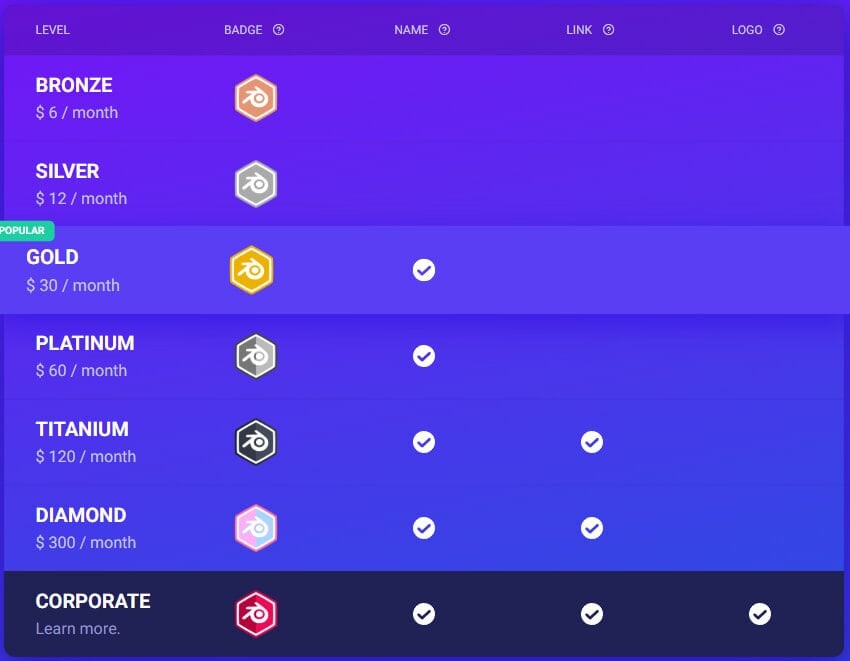
Donation plans for the development fund. Source: fund.blender.org

 The Blender Cloud is a subscription-based service that provides users access to exclusive content and tools. This includes training materials, 3D assets, and other resources that can help users to improve their skills and take advantage of the full capabilities of Blender.

Since then, Blender has become the model of success for open-source software, with a wide range of high-quality features that are on par with or better than those offered by many commercial 3D software packages. This includes advanced modeling, animation, rendering, compositing tools, and more.

It is actively developed and supported by a large and dedicated community of users, studios, organizations, and developers. It rolls out releases with new features, bug fixes, and improvements to the software regularly. Blender is constantly evolving and improving. Because Blender is open source, users can customize and extend the software in many different ways. This allows users to tailor Blender to their specific needs and workflows and to create custom tools and plugins to enhance its functionality.

And of course, one of the most significant advantages of Blender as open-source software is that it is entirely free to download and use. This makes it accessible to a wide range of users, including students, hobbyists, and independent artists-some go on to form small studios that use Blender and contribute to the fund. 

The lifeblood of Blender

Blender's community of users, organizations and developers is the lifeblood of the software. The community actively contributes to the development of Blender through testing, providing feedback and suggestions, creating custom tools and plugins, donating to the foundation's development fund, and subscribing to Blender Cloud.

However, the budding Blender Artist or someone transitioning from another software may need time to set aside funds to donate to Blender directly. Thankfully, many services, asset providers, and educators contribute a percentage of their profits to the Blender Foundation. By participating in the Blender Ecosystem, users who do not donate directly can still support Blender as they enhance their skills and workflows. For filmmakers or anyone creating long animated content, there are online render farms that contribute to the fund as well. 

GarageFarm.NET

We are a render farm that offers support for Blender cloud rendering. Our Blender render farm allows users to offload their rendering tasks to a network of powerful computers in a few clicks, with no particular scene preparation needed. The render farm is accessible through the cloud and offers a range of pricing options to suit different budgets and needs. 

We are proud to be contributors to the Blender Development Fund and, beyond that, provide a perpetual 33% discount to our Blender customers. New users get $50 worth of free credit to test our service commitment-free and without watermarks on the rendered frames. 

Blender Market

The Blender Market is an online marketplace for Blender products and services. They donate a portion of their profits to the Development Fund, so you can help support Blender's development by shopping there. On top of that, many providers also donate a share of their individual revenue. Some products that are popular investments for specific workflows that also contribute to the Development Fund are:

Auto-Rig Pro by Artell- A robust automatic character rigging solution with powerful motion capture re-targeting features. Read more about it here.

Hard Ops/ Boxcutter by Team C- Hard Ops is a Blender addon that expands on the boolean workflow introduced by the native bool tool. It is designed to make hard-surface modeling easier and more accessible in Blender. Hard Ops includes tools for boolean operations, non-destructive modeling, and assistive helpers for optimal workflows. It also has systems for sculpting and grease pencil sketching. Hard Ops has become an indispensable tool for hard-surface modeling and conceptualization in Blender.

Cinepack by Lewis Martin- CinePack is a collection of pre-animated, customizable camera moves for Blender. It is designed to save time and improve production values in Blender projects. CinePack includes a variety of camera moves that are commonly used in Hollywood movies, motion graphics, adverts, and VFX shots. The camera moves have been designed by a cinematographer with over 10 years of experience in the film industry. CinePack is an easy-to-use tool that can help users create professional-quality camera moves in Blender.

Gobos by Bproduction- Gobos is a library of textures that can be used to generate ultra-realistic shadows in Blender scenes. The asset manager makes it easy to import gobos into Blender with just one click. Gobos offers a collection of 149 HD ready textures organized into 14 categories. These textures include fixed gobos and animated gobos, as well as new animated colored gobos in the V2 version. Using Gobos can help to create scenes with volume, depth, realism, and originality.

Sketchfab

The Sketchfab Dashboard source: Sketchfab

Sketchfab is a platform for publishing, sharing, and discovering 3D content online. It allows users to upload and showcase their 3D models, which can be viewed and interacted with in a web browser. Sketchfab also offers features such as real-time rendering, animation support, and AR and VR compatibility. It is a popular destination for 3D artists and enthusiasts to share and discover 3D content and is supported by a community of users, studios, and organizations. 

Sketchfab makes money through its subscription-based business model, which offers users access to additional features and services such as increased storage and upload limits, custom domains, and advanced analytics. Sketchfab also generates revenue through partnerships with organizations and companies that use its platform to showcase and distribute 3D content. Sketchfab is a Diamond sponsor of the Blender Development Fund.

Spread the word about Blender

Tell your friends, colleagues, and anyone else interested in 3D modeling and animation about Blender and all the amazing things it can do. The more people know about it, the more support and interest it will generate.

Blender is an absolute gift to the 3D modeling and animation community. By donating to the Blender Development Fund, using services that support the fund, spreading the word about Blender, or contributing to the community, any Blender Artist can be a part of the history of Blender in helping ensure that Blender continues to improve and thrive.

---

Originally published at https://garagefarm.net.

How Ray Wakui is using Blender to push the limits of VFX in music

Article / 01 December 2022

Today we're hearing about the work of Ray Wakui and how he's working to scale up the use of visual effects within the Japanese and K-pop music video industry using Blender, Cycles, and GarageFarm's cloud render farm service. Ray is a VFX artist, video director, and musician passionate about developing high-quality, 3D-driven video productions. Alongside his video team, VeAble, Ray specializes in synthesizing live-action production and computer graphics to create some stunning visual images. If you're like Ray and also interested in trying out GarageFarm, visit our blender render farm to access $50 of free Blender render farm credits.

Building VeAble through music

Ray has worked in the industry for seven years as a video producer and artist. He started in the industry by creating music videos for his band until 2018 when he branched off into producing for other artists. 

”Neko Reset” - Zutto Mayonakade iinoni (3DCG/Composite by Ray Wakui)

‍"...Starting around 2018, I started producing music videos for other artists. [Then] around the end of 2019, I decided to use 3DCG for my band's music video and started using Blender, which is how I entered the world of CG production…."

Since then, Ray has specialized as a music video producer creating projects that interweave live-action footage with 3D visual elements, including character animations, virtual environments, and even toon-shader effects by involving other artists as needed. Most recently, Ray won the Excellence Award at the VFX-JAPAN Award 2022 in the Promotion Video Category for the work on Everything lost for his own band, THE SIXTH LIE.


‍‍"I work as a VFX artist and video director. I specialize in technology that synthesizes live-action and CG (live-action synthesis), and I have produced many music videos and commercials using green screens. I was fascinated by the image of K-pop that continuously transitioned the world, so I established the team with the goal of creating K-pop videos.... Depending on the project, I sometimes collaborate with animators and illustrators to create backgrounds in 3D using toon-style shaders."

Ray now works with his own video team, VeAble, to expand the reach and scale of music video production by making visual effects an integral part of their music video production pipeline. The team's name means Visual effects + Able, representing the group's unique skill set.

Noah Sato “LADYBUG”

‍"We established the video team "VeAble" in-house with the goal of expanding K-pop music video production with the power of VFX. We are still a small team of only a few people, but we are working on directing images without limits on the number of art sets and backgrounds we use."

Using Blender and GarageFarm for music video production

Ray uses Blender and Blender's raytraced renderer Cycles for all 3D elements in his productions and uses After Effects for compositing. The most recent project Ray worked on was for Noah Sato's music video LADYBUG. The music video combines classic pop style with colorful, virtual environments composited into the footage.


‍Ray used GarageFarm's render farm service for the first time on this project. He used the renderBeamer plug-in for Blender to render four primary visual effects sequences in the music video for a total of 343 frames. According to Ray, the process was smooth and painless. Common issues like linking models, materials, and scenes from external files posed no problems for him.

‍"At first, I was worried about setting it up while reading the explanation in the guide, but once I set it up, I could proceed with rendering without any problems. I can do other work while the render is running, so even working with only one GPU, it was efficient without unnecessary waiting time."

‍"Also, when rendering video production projects on my PC, I often render in the middle of the night or when I have free time, so it was difficult to calculate the man-hours, so clear cost estimation was also helpful for business."

A common drawback for raytraced renderers like Blender's Cycles render engine is the high-compute need for rendering glass and other highly reflective surfaces. According to Ray, using a render farm service allowed him to increase samples without sacrificing time or render quality.

‍"Blender's Cycles renderer is still not very good at expressing glass textures and reflections, and in some cases, it was necessary to use a large number of samples in order to express things properly. However, when I tried using a render farm this time, I found that even if the number of samples was considerably increased compared to rendering locally, it could be rendered in an overwhelmingly short time. It also helped improve quality."

Pushing music forward through ultra-realistic computer graphics

Despite many recent trends toward real-time rendering and the promises of the metaverse, Ray believes there's work to be done in the field of ultra-realistic 3D rendering. The work Ray has done in the music industry shows that the demand for quality over quantity still remains true. New technologies like deep learning, AI and photogrammetry, Ray hopes to take realism to new levels.

Noah Sato “LADYBUG”

‍"I'm attracted to CG that has a realistic atmosphere, texture, and smell, so I'd like to see more CG content that pursues the ultimate in realism, unlike real-time CG or the metaverse…In live-action compositing, I try to match the lighting as much as possible at the time of shooting in order to make the person blend in with the background CG, but the lighting in the real world and the lighting in the 3D never perfectly match. I'm interested in any technology that could solve this [like some recent research has tried to do]

On top of this, he's continuing to watch the process of open-source software like Blender that allows artists from all backgrounds to access next-generation creation tools.

‍"I also believe that open source programs like Blender will transform CG into an individual-based technology."

As for Ray and VeAble, they are looking to expand their work into K-pop further and learn more about how they can take influence from South Korean music videos to apply to their own work.

Noah Sato “LADYBUG”

‍As a Japanese creative team, my goal is to be involved in more music videos for K-pop artists. I always want to learn more about how filming, storyboarding, etc., is done in South Korea. I was very interested in the case studies GarageFarm published on Breezetree and Plastic Beach, which do a lot of K-pop VFX production.

Ray's commitment to learning from other styles is demonstrated throughout his work. Each piece in his portfolio brings a unique flair that never seems to repeat itself over.

Thanks for sharing with us, Ray! To learn more about Ray's work, you can visit his website www.raywakui.com.

----

Originally published at https://garagefarm.net.